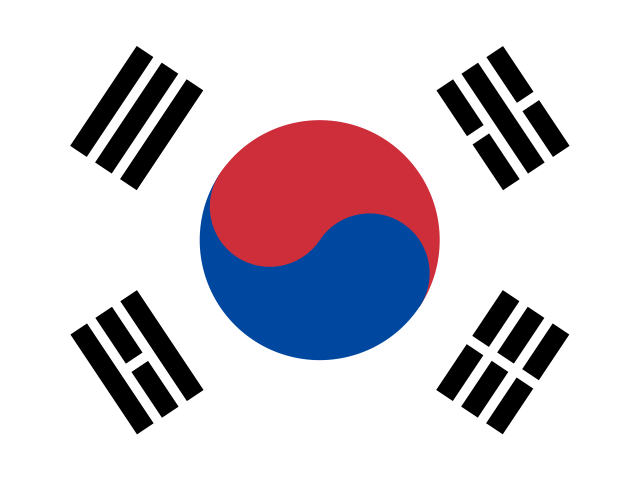
South Korea
Country in Asia
CountryScope
In brief
Population: 51.7M (2025). World rank 29 of 216; in Asia, 13 of 49. Area: 100,210 km². World rank 110 of 249; in Asia, 30 of 50. Life expectancy: 83.6 years (2024). World rank 13 of 216 (1 = best); in Asia, 4 of 49. From 2015 to 2025: population 51M → 51.7M, GDP $1.5T → $1.9T, and GDP per person $30,172 → $36,227. Better than all its neighbours (North Korea): life expectancy.
State
- Official name
- Republic of Korea
- Local name
- 한국
- Capital
- Seoul
- Region
- Asia
- Form of government
- Presidential republic
- UN member
- Yes
- Head of state
- Lee Jae Myung
- Head of government
- Han Seong-sook
- Independence
- August 15, 1945
- Women in parliament
- 20.3% 2025
Key figures
- Population
- 51,684,564 2025
- Area
- 100,210 km²
- GDP
- $1.9T 2025
- GDP per person
- $36,227 2025
- Life expectancy
- 83.6 years 2024
Practical information
- Languages
- Korean
- Currency
- South Korean Won (KRW)
- Time zones
- UTC+9
- Calling code
- +82
- Emergency numbers
- 112, 113, 119
- Driving side
- Right
- Plug types
- C, F
- Mains voltage
- 220 V
Territory
- Sea access
- Has a coastline
- Coastline, km
- 2,413
- Neighbours
- North Korea
- Agricultural land
- 16% 2024
Elevation
- Highest point
- Hallasan, 1,950 m
- Lowest point
- Sea of Japan, 0 m
- Mean elevation, m
- 282
Climate
- Average temperature in the capital, °C
- 11
- Warmest month in the capital
- August, 25°C
- Coldest month in the capital
- January, -3°C
- Precipitation, mm per year
- 1,274 2022
Population and migration
- Population density
- 515.8 per km² 2025
- Population growth per year
- -0.1% 2025
- Living in cities
- 81.2% 2025
- Net migration per year
- +65.7K 2025
- Born in another country
- 3.5% 2024
Age and life expectancy
- Aged 0–14
- 10.2% 2025
- Aged 15–64
- 69.5% 2025
- Aged 65 and over
- 20.3% 2025
- Life expectancy, women
- 86.6 years 2024
- Life expectancy, men
- 80.8 years 2024
Births and deaths
- Children per woman
- 0.8 2024
- Births per 1,000 people
- 4.7 2024
- Deaths per 1,000 people
- 7 2024
Society
- Religions
- no religion 60%, Protestant 17%, Buddhist 16%, and Catholic 6% (2021)
Quality of governance (100 = best)
- Rule of law, score 0–100
- 78.3 2025
- Control of corruption, score 0–100
- 66.7 2025
- Government effectiveness, score 0–100
- 83.1 2025
- Regulatory quality, score 0–100
- 72.8 2025
- Voice and accountability, score 0–100
- 73.8 2025
Size and growth
- GDP per person at purchasing power parity
- $63,125 2025
- GDP growth per year
- +1% 2025
Income and prices
- Income level (World Bank)
- High income
- Gross national income per person
- $37,880 2025
- Inflation
- +2.1% 2025
- Price level, USA = 100
- 57 2025
Structure and jobs
- Agriculture, share of GDP
- 1.5% 2025
- Industry, share of GDP
- 34.3% 2025
- Services, share of GDP
- 57.2% 2025
- Unemployment
- 2.7% 2025
- Youth unemployment, ages 15–24
- 6.7% 2025
- Women in work or seeking work
- 56.8% 2025
Trade and finance
- Exports, share of GDP
- 45.8% 2025
- Imports, share of GDP
- 40.6% 2025
- Current account balance, share of GDP
- +6.6% 2025
- Foreign direct investment, share of GDP
- +0.8% 2025
- Remittances received, share of GDP
- 0.4% 2025
- Tax revenue, share of GDP
- 13.3% 2024
Poverty and inequality
- Gini index (0 = full equality)
- 32.9 2021
- Living on under $3 a day
- 0.1% 2021
Education
- Adult literacy
- 98% 2008
- Primary school enrolment
- 101% 2024
- Secondary school enrolment
- 96.3% 2024
- Higher education enrolment
- 112% 2024
- Public spending on education, share of GDP
- 5.4% 2022
Healthcare
- Health spending, share of GDP
- 8.7% 2024
- Health spending per person
- $3,137 2024
- Out-of-pocket health spending, share of total
- 33.7% 2024
- Doctors per 1,000 people
- 2.6 2022
- Nurses and midwives per 1,000 people
- 9.1 2022
- Hospital beds per 1,000 people
- 12.8 2022
- Children vaccinated against measles
- 97% 2024
Public health
- Infant deaths per 1,000 births
- 2.3 2024
- Deaths under age 5 per 1,000 births
- 2.8 2024
- Maternal deaths per 100,000 births
- 4 2023
- Diabetes prevalence, ages 20–79
- 9.6% 2024
- Overweight adults
- 35.9% 2022
- Adults who use tobacco
- 18.6% 2024
Living conditions
- Access to safe drinking water
- 100% 2024
- Access to basic sanitation
- 99.7% 2024
- Access to clean cooking fuels
- 100% 2024
Safety
- Homicides per 100,000 people
- 0.5 2023
- Road deaths per 100,000 people
- 8.6 2019
- Suicides per 100,000 people
- 27.5 2021
- Political stability and absence of violence, score 0–100
- 81.7 2025
- Natural hazards
- earthquakes, volcanoes, tropical cyclones, and floods
Air and emissions
- Air pollution PM2.5, µg/m³
- 21.9 2023
- CO₂ emissions, tonnes per person
- 11.4 2024
- All greenhouse gases, tonnes CO₂e per person
- 12.9 2024
Nature and water
- Forest cover
- 64.4% 2024
- Protected areas
- 5.9% 2025
- Renewable fresh water, m³ per person
- 1,255 2022
- Water stress, share of fresh water withdrawn
- 85.2% 2022
Internet and communications
- Using the internet
- 97.9% 2024
- Mobile subscriptions per 100 people
- 173 2024
- Home broadband per 100 people
- 47.8 2024
- Internet domain
- .kr .한국
Energy
- Access to electricity
- 100% 2024
- Electricity use, kWh per person
- 12,071 2025
- Renewable share of energy use
- 3.6% 2021
- Electricity from renewables
- 6.7% 2021
- Electricity from fossil fuels
- 58.7% 2025
Transport
- Air passengers per year
- 76,272,454 2023
- Airports
- 92 2025
- Railways, km
- 3,979 2016
Science and innovation
- Research spending, share of GDP
- 4.9% 2023
- Researchers per million people
- 9,472 2023
- Scientific articles per year
- 71,724 2023
- Patent applications by residents
- 195,786 2024
- High-tech share of manufactured exports
- 36.3% 2024